通常使用TikZ-Feynman[1]绘制费曼图[2]比axodraw和feynMF/feynMP要容易许多,那俩语法稍微复杂,适合绘制更复杂的费曼图。这里我们需要的场景不用那么麻烦。如果你在论文或书籍里使用了这个宏包,请引用:doi:10.1016/j.cpc.2016.08.019或arXiv:1601.05437。
§ 配置环境
这里我们使用VSCode编辑器配合MikTeX搭建我们的 编写环境。
在VSCode配置文件settings.json中加入:
{ | |
"latex-workshop.latex.tools": [//编译工具和命令 | |
{ | |
"name": "lualatex", | |
"command": "lualatex", | |
"args": [ | |
"-synctex=1", | |
"-interaction=nonstopmode", | |
"-file-line-error", | |
"-shell-escape",//这一项需要谨慎,有可能会运行不安全的代码 | |
"-output-directory=%OUTDIR%", | |
"%DOC%" | |
] | |
} | |
], | |
"latex-workshop.latex.recipes": [//用于配置编译链 | |
{ | |
"name": "LuaLaTeX", | |
"tools": ["lualatex"] | |
} | |
] | |
} |
关于我更详细的配置请查看 LaTeX 环境配置。
引用TikZ-Feynman宏包后请在编译链中再用LuaLaTeX编译一次。
lualatex -interaction=nonstopmode -shell-escape main.tex |
\usepackage[compat=1.1.0]{tikz-feynman} |
使用compat选项是为了版本兼容性,如果不使用此项会有警告。这个包最后一次更新是2016年[3],还算稳定。
§ 示例
遇到问题,查文档(很多人就是不看文档.jpg):

texdoc tikz-feynman |
§ 线的类型
| 图像 | 类型 | 名称 |
|---|---|---|
 | plain | 普通直线 |
 | boson | 玻色子线 |
 | charged boson | 带电玻色子线 |
 | anti charged boson | 反带电玻色子线 |
 | photon | 光子线 |
 | scalar | 标量线 |
 | charged scalar | 带电标量线 |
 | anti charged scalar | 反带电标量线 |
 | ghost | 鬼线 |
 | fermion | 费米子线 |
 | anti fermion | 反费米子线 |
 | majorana | 马约拉纳费米子线 |
 | anti majorana | 反马约拉纳费米子线 |
 | gluon | 胶子线 |
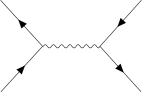
\feynmandiagram[horizontal=a to b]{ | |
i1 -- [fermion] a -- [fermion] i2, | |
a -- [photon] b, | |
f1 -- [fermion] b -- [fermion] f2, | |
}; |
\feynmandiagram[]{};指令即引入费曼图,horizontal选项就是指中间a点到b点是水平线;- 路径
i1 -> a -> i2即指左下角i1点到中间a点再到左上角i2点,线的类型都是费米子线[fermion]; - 路径
a -> b即指中间a点水平向右指向中间b点,线的类型是光子线[photon]; - 路径
f1 -> b -> f2即指右上角f1点到中间b点再到右下角f2点,线的类型都是费米子线[fermion]; ;结束费曼图环境。
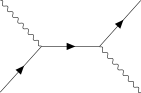
\feynmandiagram[horizontal=f2 to f3]{ | |
f1 -- [fermion] f2 -- [fermion] f3 -- [fermion] f4, | |
f2 -- [photon] p1, | |
f3 -- [photon] p2, | |
}; |
- 路径
f1 -> f2 -> f3 -> f4即指左下角f1点到中间f2点再到中间f3点再到右上角f4点,线的类型都是费米子线[fermion]; - 路径
f2 -> p1即指中间f2点指向左上角p1点,线的类型是光子线[photon]; - 路径
f2 -> p1即指中间f3点指向右下角p2点,线的类型是光子线[photon]。
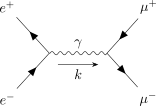
\feynmandiagram[horizontal=a to b]{ | |
i1 [particle=$e^{-}$] -- [fermion] a -- [fermion] i2 [particle=$e^{+}$], | |
a -- [photon, edge label=$\gamma$, momentum'=$k$] b, | |
f1 [particle=$\mu^{+}$] -- [fermion] b -- [fermion] f2 [particle=$\mu^{-}$], | |
}; |
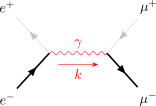
\feynmandiagram[horizontal=a to b]{ | |
i1 [particle=$e^{-}$] -- [fermion,very thick] a -- [fermion,opacity=0.2] i2 [particle=$e^{+}$], | |
a -- [photon,red,edge label=$\gamma$,momentum'={[arrow style=red]$k$}] b, | |
f1 [particle=$\mu^{+}$] -- [fermion,opacity=0.2] b -- [fermion,very thick] f2 [particle=$\mu^{-}$], | |
}; |
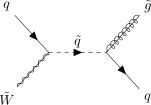
\feynmandiagram[horizontal=a to b]{ | |
i1 [particle=$\tilde{W}$] -- [plain, boson] a -- [anti fermion] i2 [particle=$q$], | |
a -- [charged scalar,edge label=$\tilde{q}$] b, | |
f1 [particle=$\tilde{g}$] -- [plain, gluon] b -- [fermion] f2 [particle=$q$], | |
}; |
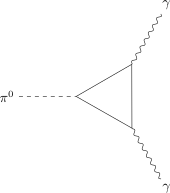
\feynmandiagram[horizontal=a to t1]{ | |
a [particle=$\pi^{0}$] -- [scalar] t1 -- t2 -- t3 -- t1, | |
t2 -- [photon] p1 [particle=$\gamma$], | |
t3 -- [photon] p2 [particle=$\gamma$], | |
}; |
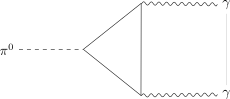
\feynmandiagram[horizontal=a to t1]{ | |
a [particle=$\pi^{0}$] -- [scalar] t1 -- t2 -- t3 -- t1, | |
t2 --[photon] p1 [particle=$\gamma$], | |
t3 --[photon] p2 [particle=$\gamma$], | |
p1 -- [opacity=0.2] p2, | |
}; |
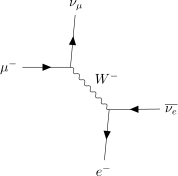
\feynmandiagram[horizontal=a to b]{ | |
a [particle=$\mu^{-}$] -- [fermion] b -- [fermion] f1 [particle=$\nu_{\mu}$], | |
b -- [boson,edge label=$W^{-}$] c, | |
f2 [particle=$\overline{\nu_{e}}$] -- [fermion] c -- [fermion] f3 [particle=$e^{-}$], | |
}; |
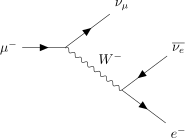
\feynmandiagram[layered layout,horizontal=a to b]{ | |
a [particle=$\mu^{-}$] -- [fermion] b -- [fermion] f1 [particle=$\nu_{\mu}$], | |
b -- [boson,edge label=$W^{-}$] c, | |
c -- [anti fermion] f2 [particle=$\overline{\nu_{e}}$], | |
c -- [fermion] f3 [particle=$e^{-}$], | |
}; |
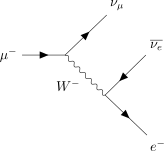
\begin{tikzpicture} | |
\begin{feynman} | |
\vertex(a) {$\mu^{-}$}; | |
\vertex[right=of a](b); | |
\vertex[above right=of b](f1){$\nu_{\mu}$}; | |
\vertex[below right=of b](c); | |
\vertex[above right=of c](f2){$\overline{\nu_{e}}$}; | |
\vertex[below right=of c](f3){$e^{-}$}; | |
\diagram*{ | |
(a)--[fermion](b)--[fermion](f1), | |
(b)--[boson,edge label'=$W^{-}$](c), | |
(c)--[anti fermion](f2), | |
(c)--[fermion](f3), | |
}; | |
\end{feynman} | |
\end{tikzpicture} |
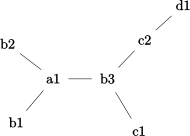
\feynmandiagram[nodes=circle,horizontal=a1 to b3]{ | |
a1 -- {b1,b2,b3 -- {c1,c2 -- d1}}, | |
}; |
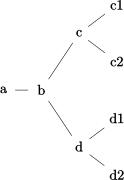
\feynmandiagram[nodes=circle,small,horizontal=a to b,tree layout]{ | |
a -- b -- {c -- {c1,c2},d -- {d1,d2}}, | |
}; |

\tikzfeynmanset{every feynman={red}} | |
\begin{center} | |
\begin{tikzpicture} | |
\node at (0,0.5){This is LZU}; | |
\begin{feynman} | |
\node at (0,-0.5){This is LZU}; | |
\end{feynman} | |
\end{tikzpicture} |
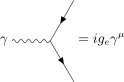
\begin{equation} | |
\feynmandiagram[inline=(d.base),horizontal=d to b]{ | |
a -- [fermion] b -- [fermion] c, | |
b -- [boson] d [particle=\gamma], | |
}; | |
=ig_{e}\gamma^{\mu}\notag | |
\end{equation} |
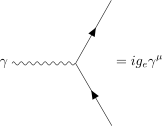
\begin{equation} | |
\feynmandiagram[baseline=(d.base),horizontal=d to b]{ | |
a -- [fermion] b -- [fermion] c, | |
b -- [boson] d [particle=\gamma], | |
}; | |
=ig_{e}\gamma^{\mu}\notag | |
\end{equation} |


\feynmandiagram[inline=(b),horizontal=a to b,red]{ | |
a [particle=$a$] -- b [particle=$b$] -- {c [particle=$c$], d [particle=$d$]}, | |
}; | |
\feynmandiagram[inline=(b),horizontal'=a to b,blue]{ | |
a [particle=$a$] -- b [particle=$b$] -- {c [particle=$c$], d [particle=$d$]}, | |
}; | |
\feynmandiagram[inline=(b),vertical=a to b,green!40!black]{ | |
a [particle=$a$] -- b [particle=$b$] -- {c [particle=$c$], d [particle=$d$]}, | |
}; | |
\feynmandiagram[inline=(b),vertical'=a to b,black]{ | |
a [particle=$a$] -- b [particle=$b$] -- {c [particle=$c$], d [particle=$d$]}, | |
}; |

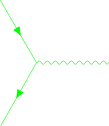
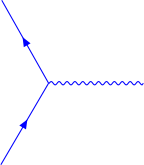
\tikzfeynmanset{every diagram={red}} | |
\feynmandiagram[small,horizontal=a to b]{ | |
i1 -- [fermion] a -- [fermion] i2, | |
a -- [boson] b, | |
}; | |
\tikzfeynmanset{every diagram={green}} | |
\feynmandiagram[medium,horizontal=a to b]{ | |
i1 -- [fermion] a -- [fermion] i2, | |
a -- [boson] b, | |
}; | |
\tikzfeynmanset{every diagram={blue}} | |
\feynmandiagram[large,horizontal=a to b]{ | |
i1 -- [fermion] a -- [fermion] i2, | |
a -- [boson] b, | |
}; |
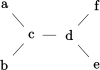
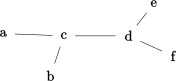
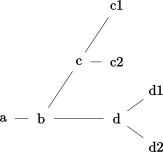
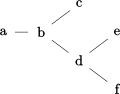
\feynmandiagram[nodes=circle,small,horizontal=c to d]{ | |
{a, b} -- c -- d -- {e, f}, | |
}; | |
\feynmandiagram[nodes=circle,small,horizontal=c to d,spring electrical layout]{ | |
{a, b [electric charge=2]} -- c -- d -- {e, f [electric charge=0.1]}, | |
}; | |
\feynmandiagram[nodes=circle,small,horizontal=a to b,layered layout]{ | |
a -- b -- {c -- {c1, c2}, d -- {d1, d2}}, | |
{[same layer] c1, d} | |
}; | |
\feynmandiagram[nodes=circle,small,horizontal=a to b,tree layout]{ | |
a -- b -- {c, d -- {e, f}} | |
}; |
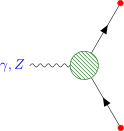
\tikzfeynmanset{ | |
every vertex={red,dot}, | |
every particle={blue}, | |
every blob={draw=green!40!black, pattern color=green!40!black}, | |
} | |
\feynmandiagram[horizontal=a to b]{ | |
a [particle={$\gamma, Z$}] -- [boson] b [blob], | |
c -- [fermion] b -- [fermion] d, | |
}; |


\feynmandiagram[small]{ | |
a -- b [dot] -- {c, d}, | |
}; | |
\feynmandiagram[small]{ | |
a -- b [square dot] -- {c, d}, | |
}; | |
\feynmandiagram[small]{ | |
a -- b [empty dot] -- {c, d}, | |
}; | |
\feynmandiagram[small]{ | |
a -- b [crossed dot] -- {c, d}, | |
}; | |
\feynmandiagram[small]{ | |
a -- b [blob] -- {c, d} | |
}; |
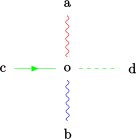
\tikzfeynmanset{ | |
every edge={green}, | |
every boson={red}, | |
every photon={blue}, | |
} | |
\feynmandiagram[nodes=circle,small]{ | |
a -- [boson] o -- [photon] b, | |
c -- [fermion] o --[scalar] d, | |
}; |
§ 其他例子
在以下例子中,使用standalone文档类
lualatex -interaction=nonstopmode -shell-escape main.tex |
编译出PDF文件后自动裁边并转换成svg矢量图。
- 电子-正电子湮灭
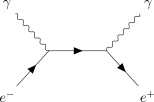
\documentclass[margin=5pt, convert, convert={outext=.svg, command=\unexpanded{ | |
% pdf2svg \infile\space \outfile | |
pdfcrop \infile\space \infile && pdftocairo -svg \infile % 不喜欢用 pdf2svg | |
}}]{standalone} | |
\usepackage[compat=1.1.0]{tikz-feynman} | |
\begin{document} | |
\feynmandiagram[horizontal=f2 to f3]{ | |
f1 [particle=$e^{-}$] -- [fermion] f2, | |
f2 -- [photon] p1 [particle=$\gamma$], | |
f2 -- [fermion] f3, | |
f3 -- [photon] p2 [particle=$\gamma$], | |
f3 -- [fermion] f4 [particle=$e^{+}$], | |
}; | |
\end{document} |
- Rosenbluth formula
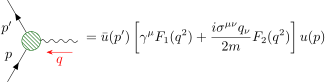
lualatex -interaction=nonstopmode -shell-escape main.tex | ||
pdfcrop main.pdf main.pdf && pdftocairo -svg main.pdf |
\documentclass{article} | |
\usepackage{amsmath,amssymb} | |
\usepackage[compat=1.1.0]{tikz-feynman} | |
\begin{document} | |
\pagestyle{empty} | |
\begin{equation} | |
\tikzfeynmanset{ | |
every vertex={red}, | |
every particle={blue}, | |
every blob={draw=green!40!black, pattern color=green!40!black}, | |
} | |
\feynmandiagram[inline=(c.base), horizontal=o to c]{ | |
a -- [fermion, edge label=$p$] o [blob], | |
o -- [fermion, edge label=$p^{\prime}$] b, | |
c --[boson,momentum={[arrow style=red]$q$}] o, | |
}; | |
\;=\bar{u}(p^{\prime})\left[\gamma^{\mu}F_1(q^{2})+\frac{i\sigma^{\mu\nu}q_{\nu}}{2m}F_2(q^{2})\right]u(p)\notag | |
\end{equation} | |
\end{document} |
- 顶点规则
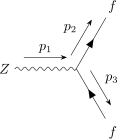
\documentclass[margin=5pt, convert, convert={outext=.svg, command=\unexpanded{ | |
pdfcrop \infile\space \infile && pdftocairo -svg \infile | |
}}]{standalone} | |
\usepackage[compat=1.1.0]{tikz-feynman} | |
\begin{document} | |
\feynmandiagram[horizontal=a to b]{ | |
a [particle=\(Z\)] -- [photon, momentum=\(p_{1}\)] b, | |
f1 [particle=\(\overline f\)] | |
-- [fermion, rmomentum'=\(p_{3}\)] b | |
-- [fermion, momentum=\(p_{2}\)] f2 [particle=\(f\)], | |
}; | |
\end{document} |
- 树状图
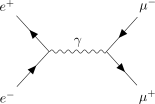
\documentclass[margin=5pt, convert, convert={outext=.svg, command=\unexpanded{ | |
pdfcrop \infile\space \infile && pdftocairo -svg \infile | |
}}]{standalone} | |
\usepackage[compat=1.1.0]{tikz-feynman} | |
\begin{document} | |
\feynmandiagram[horizontal=a to b]{ | |
i1 [particle=\(e^{-}\)] -- [fermion] a -- [fermion] i2 [particle=\(e^{+}\)], | |
a -- [photon, edge label=\(\gamma\)] b, | |
f1 [particle=\(\mu^{-}\)] -- [fermion] b -- [fermion] f2 [particle=\(\mu^{+}\)], | |
}; | |
\end{document} |
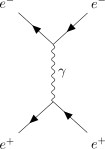
\documentclass[margin=5pt, convert, convert={outext=.svg, command=\unexpanded{ | |
pdfcrop \infile\space \infile && pdftocairo -svg \infile | |
}}]{standalone} | |
\usepackage[compat=1.1.0]{tikz-feynman} | |
\begin{document} | |
\feynmandiagram[vertical'=a to b]{ | |
i1 [particle=\(e^{-}\)] | |
-- [fermion] a | |
-- [fermion] f1 [particle=\(e^{-}\)], | |
a -- [photon, edge label=\(\gamma\)] b, | |
i2 [particle=\(e^{+}\)] | |
-- [anti fermion] b | |
-- [anti fermion] f2 [particle=\(e^{+}\)], | |
}; | |
\end{document} |
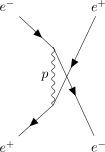
\documentclass[margin=5pt, convert, convert={outext=.svg, command=\unexpanded{ | |
pdfcrop \infile\space \infile && pdftocairo -svg \infile | |
}}]{standalone} | |
\usepackage[compat=1.1.0]{tikz-feynman} | |
\begin{document} | |
\begin{tikzpicture} | |
\begin{feynman} | |
\diagram[vertical'=a to b]{ | |
i1 [particle=\(e^{-}\)] | |
-- [fermion] a | |
-- [draw=none] f1 [particle=\(e^{+}\)], | |
a -- [photon, edge label'=\(p\)] b, | |
i2 [particle=\(e^{+}\)] | |
-- [anti fermion] b | |
-- [draw=none] f2 [particle=\(e^{-}\)], | |
}; | |
\diagram*{ | |
(a) -- [fermion] (f2), | |
(b) -- [anti fermion] (f1), | |
}; | |
\end{feynman} | |
\end{tikzpicture} | |
\end{document} |
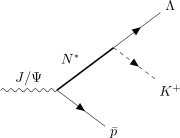
\documentclass[margin=5pt, convert, convert={outext=.svg, command=\unexpanded{ | |
pdfcrop \infile\space \infile && pdftocairo -svg \infile | |
}}]{standalone} | |
\usepackage[compat=1.1.0]{tikz-feynman} | |
\begin{document} | |
\feynmandiagram[layered layout,horizontal=a to b]{ | |
a -- [boson, edge label=$J/\Psi$] b | |
-- [plain, very thick, edge label=$N^{*}$] c | |
-- [fermion] d [particle=$\Lambda$], | |
b -- [fermion] f1 [particle=$\bar{p}$], | |
c -- [charged scalar] f2 [particle=$K^{+}$], | |
}; | |
\end{document} |
- 循环
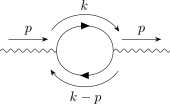
\documentclass[margin=5pt, convert, convert={outext=.svg, command=\unexpanded{ | |
pdfcrop \infile\space \infile && pdftocairo -svg \infile | |
}}]{standalone} | |
\usepackage[compat=1.1.0]{tikz-feynman} | |
\begin{document} | |
\feynmandiagram[layered layout, horizontal=b to c]{ | |
a -- [photon, momentum=\(p\)] b | |
-- [fermion, half left, momentum=\(k\)] c | |
-- [fermion, half left, momentum=\(k-p\)] b, | |
c -- [photon, momentum=\(p\)] d, | |
}; | |
\end{document} |
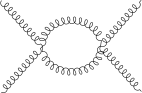
\documentclass[margin=5pt, convert, convert={outext=.svg, command=\unexpanded{ | |
pdfcrop \infile\space \infile && pdftocairo -svg \infile | |
}}]{standalone} | |
\usepackage[compat=1.1.0]{tikz-feynman} | |
\begin{document} | |
\feynmandiagram[layered layout, horizontal=b to c]{ | |
a -- [photon, momentum=\(p\)] b | |
-- [fermion, half left, momentum=\(k\)] c | |
-- [fermion, half left, momentum=\(k-p\)] b, | |
c -- [photon, momentum=\(p\)] d, | |
}; | |
\end{document} |
- 箱形图
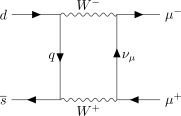
\documentclass[margin=5pt, convert, convert={outext=.svg, command=\unexpanded{ | |
pdfcrop \infile\space \infile && pdftocairo -svg \infile | |
}}]{standalone} | |
\usepackage[compat=1.1.0]{tikz-feynman} | |
\begin{document} | |
\feynmandiagram[layered layout, horizontal=a to b]{ | |
% 画顶部和底部线 | |
i1 [particle=\(d\)] | |
-- [fermion] a | |
-- [photon, edge label=\(W^{-}\)] b | |
-- [fermion] f1 [particle=\(\mu^{-}\)], | |
i2 [particle=\(\overline s\)] | |
-- [anti fermion] c | |
-- [photon, edge label'=\(W^{+}\)] d | |
-- [anti fermion] f2 [particle=\(\mu^{+}\)], | |
% 绘制两条内部费米子线 | |
{ [same layer] a -- [fermion, edge label'=\(q\)] c }, | |
{ [same layer] b -- [anti fermion, edge label=\(\nu_{\mu}\)] d}, | |
}; | |
\end{document} |
- 介子衰变和混合
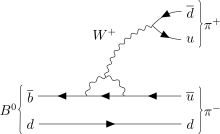
\documentclass[margin=5pt, convert, convert={outext=.svg, command=\unexpanded{ | |
pdfcrop \infile\space \infile && pdftocairo -svg \infile | |
}}]{standalone} | |
\usepackage[compat=1.1.0]{tikz-feynman} | |
\begin{document} | |
\begin{tikzpicture} | |
\begin{feynman} | |
\vertex (a1) {\(\overline b\)}; | |
\vertex[right=1.5cm of a1] (a2); | |
\vertex[right=1cm of a2] (a3); | |
\vertex[right=1.5cm of a3] (a4) {\(\overline u\)}; | |
\vertex[below=2em of a1] (b1) {\(d\)}; | |
\vertex[below=2em of a4] (b2) {\(d\)}; | |
%% 看第 13.5 节 PGF / TikZ 手册 | |
\vertex at ($(a2)!0.5!(a3)!0.5cm!90:(a3)$) (d); | |
%% 获得 (d) 的等效方法: | |
% \vertex at ($(b2)!0.5!(b3) + (0, -0.5cm)$) (d); | |
\vertex[above=of a4] (c1) {\(u\)}; | |
\vertex[above=2em of c1] (c3) {\(\overline d\)}; | |
\vertex at ($(c1)!0.5!(c3) - (1cm, 0)$) (c2); | |
\diagram*{ | |
(a4) -- [fermion] (a3) -- [fermion] (a2) -- [fermion] (a1), | |
(b1) -- [fermion] (b2), | |
(c3) -- [fermion, out=180, in=45] (c2) -- [fermion, out=-45, in=180] (c1), | |
(a2) -- [boson, quarter left] (d) -- [boson, quarter left] (a3), | |
(d) -- [boson, bend left, edge label=\(W^{+}\)] (c2), | |
}; | |
\draw[decoration={brace}, decorate] (b1.south west) -- (a1.north west) | |
node [pos=0.5, left] {\(B^{0}\)}; | |
\draw[decoration={brace}, decorate] (c3.north east) -- (c1.south east) | |
node [pos=0.5, right] {\(\pi^{+}\)}; | |
\draw[decoration={brace}, decorate] (a4.north east) -- (b2.south east) | |
node [pos=0.5, right] {\(\pi^{-}\)}; | |
\end{feynman} | |
\end{tikzpicture} | |
\end{document} |
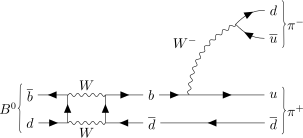
\documentclass[margin=5pt, convert, convert={outext=.svg, command=\unexpanded{ | |
pdfcrop \infile\space \infile && pdftocairo -svg \infile | |
}}]{standalone} | |
\usepackage[compat=1.1.0]{tikz-feynman} | |
\begin{document} | |
\begin{tikzpicture} | |
\begin{feynman} | |
\vertex (a1) {\(\overline b\)}; | |
\vertex[right=1cm of a1] (a2); | |
\vertex[right=1cm of a2] (a3); | |
\vertex[right=1cm of a3] (a4) {\(b\)}; | |
\vertex[right=1cm of a4] (a5); | |
\vertex[right=2cm of a5] (a6) {\(u\)}; | |
\vertex[below=2em of a1] (b1) {\(d\)}; | |
\vertex[right=1cm of b1] (b2); | |
\vertex[right=1cm of b2] (b3); | |
\vertex[right=1cm of b3] (b4) {\(\overline d\)}; | |
\vertex[below=2em of a6] (b5) {\(\overline d\)}; | |
\vertex[above=of a6] (c1) {\(\overline u\)}; | |
\vertex[above=2em of c1] (c3) {\(d\)}; | |
\vertex at ($(c1)!0.5!(c3) - (1cm, 0)$) (c2); | |
\diagram*{ | |
{[edges=fermion] | |
(b1) -- (b2) -- (a2) -- (a1), | |
(b5) -- (b4) -- (b3) -- (a3) -- (a4) -- (a5) -- (a6), | |
}, | |
(a2) -- [boson, edge label=\(W\)] (a3), | |
(b2) -- [boson, edge label'=\(W\)] (b3), | |
(c1) -- [fermion, out=180, in=-45] (c2) -- [fermion, out=45, in=180] (c3), | |
(a5) -- [boson, bend left, edge label=\(W^{-}\)] (c2), | |
}; | |
\draw[decoration={brace}, decorate] (b1.south west) -- (a1.north west) | |
node [pos=0.5, left] {\(B^{0}\)}; | |
\draw[decoration={brace}, decorate] (c3.north east) -- (c1.south east) | |
node [pos=0.5, right] {\(\pi^{-}\)}; | |
\draw[decoration={brace}, decorate] (a6.north east) -- (b5.south east) | |
node [pos=0.5, right] {\(\pi^{+}\)}; | |
\end{feynman} | |
\end{tikzpicture} | |
\end{document} |
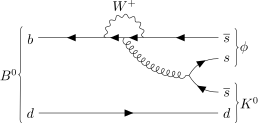
\documentclass[margin=5pt, convert, convert={outext=.svg, command=\unexpanded{ | |
pdfcrop \infile\space \infile && pdftocairo -svg \infile | |
}}]{standalone} | |
\usepackage[compat=1.1.0]{tikz-feynman} | |
\begin{document} | |
\begin{tikzpicture} | |
\begin{feynman} | |
\vertex (a1) {\(\overline b\)}; | |
\vertex[right=2cm of a1] (a2); | |
\vertex[right=0.5cm of a2] (a3); | |
\vertex[right=0.5cm of a3] (a4); | |
\vertex[right=2cm of a4] (a5) {\(\overline s\)}; | |
\vertex[below=2cm of a1] (b1) {\(d\)}; | |
\vertex[below=2cm of a5] (b2) {\(d\)}; | |
\vertex[below=1.5em of a5] (c1) {\(s\)}; | |
\vertex[above=1.5em of b2] (c3) {\(\overline s\)}; | |
\vertex at ($(c1)!0.5!(c3) - (1cm, 0)$) (c2); | |
\diagram*{ | |
{[edges=fermion] | |
(a5) -- (a4) -- (a3) -- (a2) -- (a1), | |
}, | |
(b1) -- [fermion] (b2), | |
(c3) -- [fermion, out=180, in=-60] (c2) -- [fermion, out=60, in=180] (c1), | |
(a3) -- [gluon, bend right] (c2), | |
(a4) -- [boson, out=90, in=90, looseness=2.0, edge label'=\(W^{+}\)] (a2) | |
}; | |
\draw[decoration={brace}, decorate] (b1.south west) -- (a1.north west) | |
node [pos=0.5, left] {\(B^{0}\)}; | |
\draw[decoration={brace}, decorate] (a5.north east) -- (c1.south east) | |
node [pos=0.5, right] {\(\phi\)}; | |
\draw[decoration={brace}, decorate] (c3.north east) -- (b2.south east) | |
node [pos=0.5, right] {\(K^{0}\)}; | |
\end{feynman} | |
\end{tikzpicture} | |
\end{document} |
- 三个 gluon 的 interaction vertex
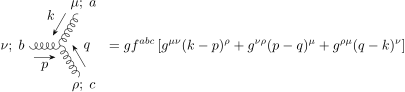
\documentclass{article} | |
\usepackage{amsmath,amssymb} | |
\usepackage[compat=1.1.0]{tikz-feynman} | |
\begin{document} | |
\pagestyle{empty} | |
\begin{equation} | |
\feynmandiagram[inline=(a.base), horizontal=a to b]{ | |
a [particle=$\nu;\;b$] -- [gluon, momentum'=$p$] b, | |
c [particle=$\mu;\;a$] -- [gluon, momentum'=$k$] b, | |
d [particle=$\rho;\;c$] -- [gluon, momentum'=$q$] b, | |
}; | |
\;=gf^{abc}\left[g^{\mu\nu}(k-p)^{\rho}+g^{\nu\rho}(p-q)^{\mu}+g^{\rho\mu}(q-k)^{\nu}\right]\notag | |
\end{equation} | |
\end{document} |